Pixels were never the upgrade
The biggest movie Netflix ever released streams in 1080p, and it takes 16 months and a Criterion disc to show up in 4K.
The biggest thing Netflix ever released streams in 1080p.
KPop Demon Hunters. Worldwide phenomenon, the songs everywhere, the most-watched movie in the service’s history. It launched in full HD with HDR, and as I write this there is still no 4K stream of it. The 4K version arrives on November 3rd — on a disc, from the Criterion Collection, about 16 months after the thing came out.
The most-watched title on the biggest streaming service on earth didn’t need 4K to become the most-watched title on the biggest streaming service on earth. And when 4K finally arrives, the way you get it is by buying physical media.
Every few years the industry hands us a new number and tells us it’s the upgrade. Right now the number is 8K. Before that it was 4K. But the thing that actually made pictures better was high dynamic range, and the pixel count got the marketing budget.
Which is exactly what that Netflix stream is. It’s 1080p, and it’s HDR. It got the upgrade that matters and skipped the one on the box.
My in-laws watched a different episode than I did
There’s an episode of Game of Thrones — the Battle of Winterfell, the one that’s dark for basically its entire runtime, castle under siege, a lot of fire. Famously hard to watch. People blamed the cinematographer.
My in-laws watched it at home on an uncalibrated 1080p Samsung. Not an OLED, so nothing like that contrast ratio. Then they came to our place — we were in a townhouse in Leesburg then, and I had a theater in it with a native 4K JVC and good contrast.
They had no idea how much of that episode they had missed. The blacks were crushed on what they’d watched at home. Whole sections of the frame that they’d seen as a flat dark smear had things happening in them.
That’s the demo I’d want to give every customer who asks me whether 4K is worth it, because the answer they need isn’t about pixels at all. Notice that resolution was only one of about four things that changed between those two viewings.
Worth knowing: the cinematographer, Fabian Wagner, took the blame publicly and didn’t accept it. He pointed at HBO’s compression, at people’s internet connections, and — the line that got him roasted — at the fact that a lot of people don’t know how to tune their TVs properly. He was being blunt about it, but he wasn’t wrong. That’s a compression problem and a calibration problem wearing a cinematography costume.
Sitting too far away from a screen that’s too small
So what is actually going on. Start with the simplest part: whether you can see 4K at all depends on how big the screen is relative to how far away you’re sitting.
The TV in our family room is 43 inches, and I watch it from 10 to 12 feet away on the couch. I want to believe I can see the difference between 1080p and 4K on it. I’m not sure I can.
Now go down to my basement — 143 inches diagonal, Cinemascope, an Epson LS12000. A good high-bitrate 4K stream there is leaps and bounds better than the same content on the 43-inch. Same signal. Completely different outcome.
Most people are sitting 10-plus feet from a 55 or 65-inch set. That’s the mainstream setup, and it’s right at the edge of where 4K stops announcing itself.
The number nobody puts on the box
The second thing is bitrate, and this is the one customers have never heard of.
The Blu-ray Disc Association’s own numbers for Ultra HD Blu-ray: a dual layer 66GB disc carries video up to 108 Mbps, and a triple layer 100GB disc up to 128 Mbps.
Now Netflix. Their premium 4K streams launched on a fixed ladder of 8, 10, 12 and 16 Mbps. Then they moved to shot-based encoding that, by their own account, cuts 4K bitrates roughly in half at the same perceived quality.
A 4K disc has an order of magnitude more data to work with than a 4K stream, and the streaming number has been going down.
(One correction while we’re here, because it gets repeated constantly: the 17 Mbps figure people quote for Netflix 4K is the minimum internet speed they recommend. It is not the bitrate of the video. Those are different things.)
And “4K” doesn’t mean one thing across services. Somebody has been measuring median bitrates title by title, and the spread is wide: Apple TV+ around 26 Mbps, HBO Max 21, Prime Video 19, Netflix 16, Disney+ 15, Paramount+ 12. That’s third-party measurement rather than published spec, so hold it loosely — but the shape of it is the point. The same badge on the same screen can mean twice the data or half of it depending on whose app you opened.
Which means a high-bitrate 1080p source can look better than a low-bitrate 4K stream. Just because the badge says 4K doesn’t mean what’s arriving is better than the 1080p you were watching before.
And compression artifacts show up worst exactly where that Game of Thrones episode lived: dark scenes, smoke, fire, subtle gradients in shadow. Low bitrate turns all of that into blocky mud. More pixels doesn’t save you. There’s no data there to put in them.
Is the 1080p tier being held down on purpose?
I assumed it was. If 4K is being served in the teens, the 1080p tier has to be thin, and it’s tempting to think somebody wants the upgrade to look worth paying for.
I went looking, and the evidence doesn’t support that. Netflix’s old fixed ladder did top out 1080p at 5,800 kbps, which sounds stingy. But what replaced it explains the number without any bad intent: per-title encoding. Netflix’s own published example took an animated title down from a 5,800 kbps top rung to 2,000 kbps with no visible quality loss, while a high-motion title stayed up in the 4,500 to 5,800 range. Across the catalogue, about 20 percent bandwidth saved at the same measured quality.
That’s not a thumb on the scale. That’s cartoons genuinely needing less data than a battle scene. The 1080p tier looks thin because encoders got good at spending only what a given shot actually needs.
The practical result is the same either way — your 1080p stream is carrying a lot less than a 1080p disc — but it’s worth knowing the reason is engineering rather than a scheme.
The projector that fakes it and wins
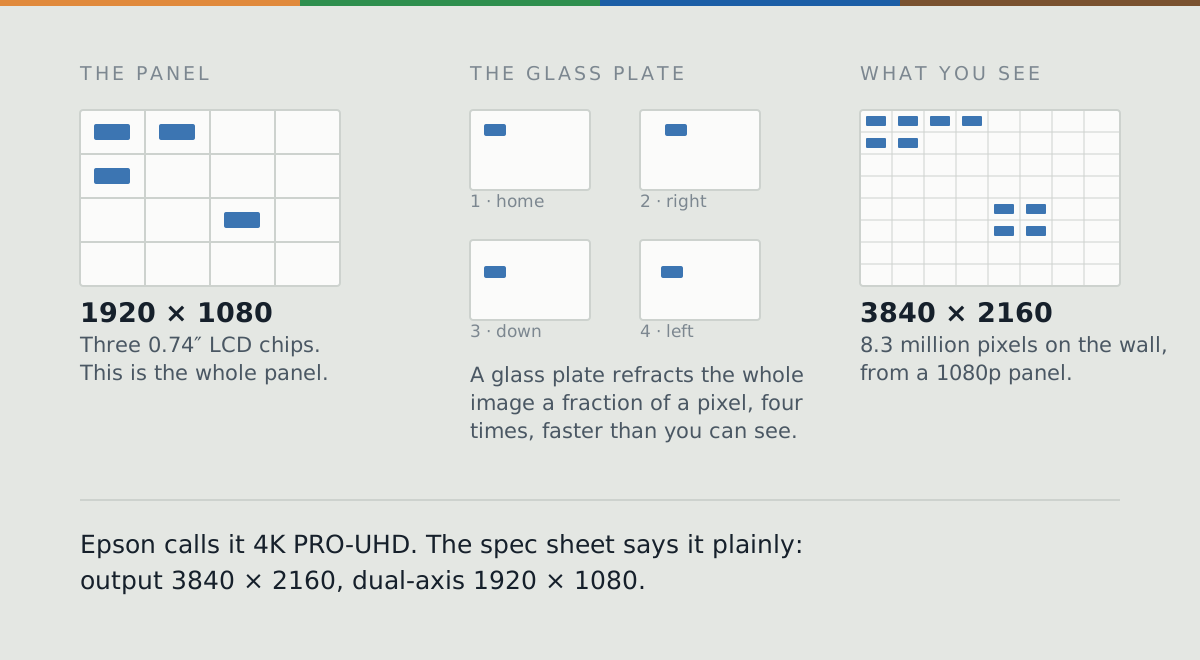
My LS12000 does not have 4K panels. It has three native 1080p LCD chips and a precision shift glass plate that refracts the image through four phases on two axes, fast enough that your eye assembles 8.3 million pixels out of it. Epson’s own spec sheet says it plainly: output resolution 3840x2160, dual-axis 1920x1080.
Technically, you are watching 1080p panels wiggle.
And it looks dramatically better than a 1080p projector. In a lot of cases it stands right up against a native 4K projector — especially when the shifting unit brings more brightness and better contrast to the fight. Not all shifting is even equal: that four-phase shift puts up roughly double the pixels an older JVC e-shift does.
A fake 4K beating a real 1080p and holding its own against a real 4K. If pixels were the thing, that couldn’t happen.
Because the count of pixels on the screen has nothing to do with contrast. Nothing to do with dynamic range. Nothing to do with brightness, or compression artifacts. In a lot of cases it has nothing to do with the quality of the image at all.
Where the budget actually goes
The clearest version of this is video games, and it’s where a lot of the 8K push is coming from. Games are a good showcase — object-based audio, everything mixed exactly as the designers intended, reproduced close to how it was mastered.
But games have no bitrate to blame. What they have is a rendering budget. Every pixel you spend on resolution is one you didn’t spend on geometry, shadows, physics, or draw distance.
So you can look at a racing game and think the track and the cars are gorgeous, lifelike. Then you look to the side. The spectators are flat. The hills in the distance are flat. The grass is flat. Walk through it in an open-world game and it’s 2D blades with no shadows and no physics.
That’s not a resolution problem, and resolution can’t fix it. Resolution doesn’t create detail nobody authored. It just lets you see the flatness more clearly.
It’s also why consoles ship performance modes and dynamic resolution. Developers already worked this out. Resolution is the cheapest thing on the list to sacrifice, so it’s the first thing they drop to hold a frame rate.
So, 8K
Now put 8K on top of all that.
The content isn’t there — and the KPop Demon Hunters situation is the proof. We are not in a world where 4K is so abundant that we need the next thing. We’re in a world where the most-watched movie Netflix has ever released streams in 1080p and takes 16 months and a Criterion disc to show up in 4K.
The delivery isn’t there either. If our internet can’t carry true high-bitrate 4K — and the numbers above say it isn’t even trying — then 8K needs bigger files, higher bitrates, and physical discs that hold more. It’s taxing before it ever leaves the server. Plenty of home networks can’t reliably move an 80 Mbps stream around the house on consumer Wi-Fi, let alone pull it down from the ISP.
Codecs help. H.265 was built to deliver the same or better quality at a smaller size than H.264, and that kind of work will keep happening. But there’s always a trade-off, and you don’t get to skip the physics.
None of this means 4K was a lie. On a big screen, with a bright display with a real black floor, fed by a high-bitrate source, 4K is fantastic. I sell it. I install it. I watch it.
It means the number on the box was never the reason it looked good.