What HDR actually does, and why it's so hard to show you
The move to 4K got sold on pixels. The real upgrade was HDR, which keeps the detail at both ends of the picture that standard video throws away.
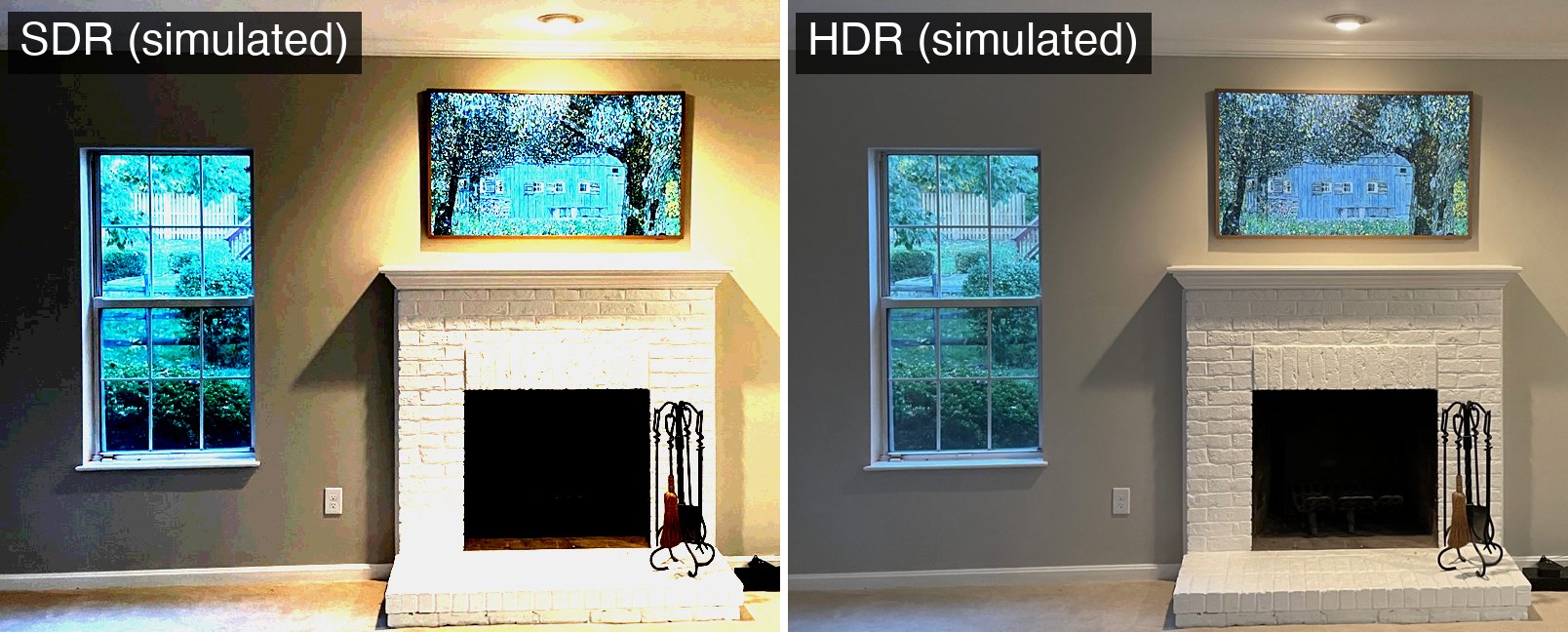
The upgrade from 1080p to 4K got sold on pixel count. That wasn’t the upgrade. HDR was the upgrade, and it arrived in the same box at the same time, which is how it ended up as the second line on the spec sheet.
The range
Picture a room with a candle burning and a window behind it with full sun outside.
Your eyes handle both at once. You see the flame as a flame, with shape and color and a dark core. You see the window as a window, with a tree and a sky and clouds. No effort. You’re not choosing.
A camera has to choose. Expose for the window and the room goes black — the candle is a white dot in a void. Expose for the room and the window blows out — a rectangle of pure white where the outdoors used to be.
That’s standard dynamic range video. One exposure decision applied to the entire frame. Everything brighter than the top of the range clips to white. Everything darker than the bottom crushes to black. The picture is real in the middle and gone at both ends.
HDR is the display doing what your eyes do. The flame stays a flame. The window stays a window. Same shot, same frame, at the same time.
The part people get wrong: it isn’t about brightness
The obvious reading of “high dynamic range” is “brighter TV,” and that reading is wrong in the way that matters.
What you actually gain is steps. More distinguishable increments of luminance between full black and full white, and more distinguishable shades of color at each of those increments. Standard video carries 256 levels per color channel. HDR10 carries 1,024, and Dolby Vision can carry 4,096.
And what steps buy you is data.
When a bright area of the frame has real steps in it, you keep the texture. Clouds have structure instead of being a white shape. A chrome bumper in sunlight has a gradient across it instead of a flare. When a dark area has real steps, the shadow under a car has something in it — a shape, a ground texture, a second object — instead of being a hole in the image.
HDR doesn’t give you a brighter picture. It gives you more of the picture.
The detail was always in the scene. Standard dynamic range threw away the top and the bottom of it. HDR keeps it.
The other half: the TV finally does what it’s told
There’s a second thing HDR changed that gets even less attention than the first.
Standard video only ever said “make this bright.” Relatively. And every display on earth interpreted that instruction differently — different panel, different processing, different idea of what “bright” meant. Same disc, same signal, 10 TVs, 10 answers.
The HDR on discs and streaming services — HDR10 and Dolby Vision — says “make this exactly this bright.” As an absolute number. And the display obeys it, within whatever it’s physically capable of.
When a movie asks for a highlight brighter than the TV can make, the TV has to decide what to do with the difference, and every manufacturer handles that its own way. So the instruction is exact. What you get is exact right up to the limit of the hardware you bought.
Why you’ve never seen a fair comparison
Customers never see the before.
We install a projector, we calibrate it, and we hand over a picture that’s correct from the first frame. The client has no baseline. They’ve never watched the uncalibrated, non-HDR version of the movie on that screen in that room. They only ever see the after. Which means they genuinely don’t know what they got — they just know it looks good.
And I’ve never seen a fair side-by-side.
Not at a dealer, not at a trade show, and not in the certification classroom either. I went through Level III calibration training with the Imaging Science Foundation, the ISF, which Joel Silver founded in 1994. We never had two identical displays sitting next to each other showing the same content, one in HDR and one in SDR.
That setup is the only honest way to do it, and it takes two of everything.
Because on one screen, it’s structurally impossible.
Put HDR content on a display and it switches into HDR mode. Every pixel on that panel is now being handled under HDR rules. So if you try to show an “SDR half” of the frame, you aren’t showing SDR — you’re showing SDR content being rendered by a display in HDR mode, which is not a faithful representation of anything.
Flip it the other way. Keep the display in SDR mode and feed it the HDR half, and now you’re watching HDR content mangled into SDR. Also not faithful.
There is no third option. The display has one mode at a time, and the comparison you want to see requires two.
So what you’ve actually seen — every HDR-versus-SDR image you’ve ever looked at, including the one at the top of this post — is a simulation. An illustration of the idea, drawn on whatever display you happen to be reading this on. It’s a drawing of the difference, not the difference.
That’s not a scandal. It’s just worth knowing, because it means your own eyes on your own good display are the only real demo, and you can’t get a look at the alternative.
What this means when you’re buying
The room is part of the system. HDR’s range only opens up if the room lets both ends of it exist. A television in a bright sunlit room can show you the top of the range beautifully and simply cannot deliver the bottom — there’s too much ambient light for black to be black. A projector has the mirror-image situation: give it a properly dark room and the black floor is excellent, but peak brightness is the constrained end. Neither is a defect. They’re different halves of the same range, and which one you can actually use depends on the room you’re putting it in.
And the specs that matter aren’t the resolution. For HDR the questions are how bright the display gets, how dark it gets, how much of the color volume it covers, and — for a TV — how precisely it can control light across the panel. Those are the numbers doing the work. The pixel count on the front of the box is not.
Most of the technical background in this post comes from ISF’s training. The material is excellent, and it was never written for the people actually buying the TV. The translation is mine.