What I actually tell people to buy when they ask about home security
I worked in product at Alarm.com and I install all of this for a living. Here's the version without the marketing.
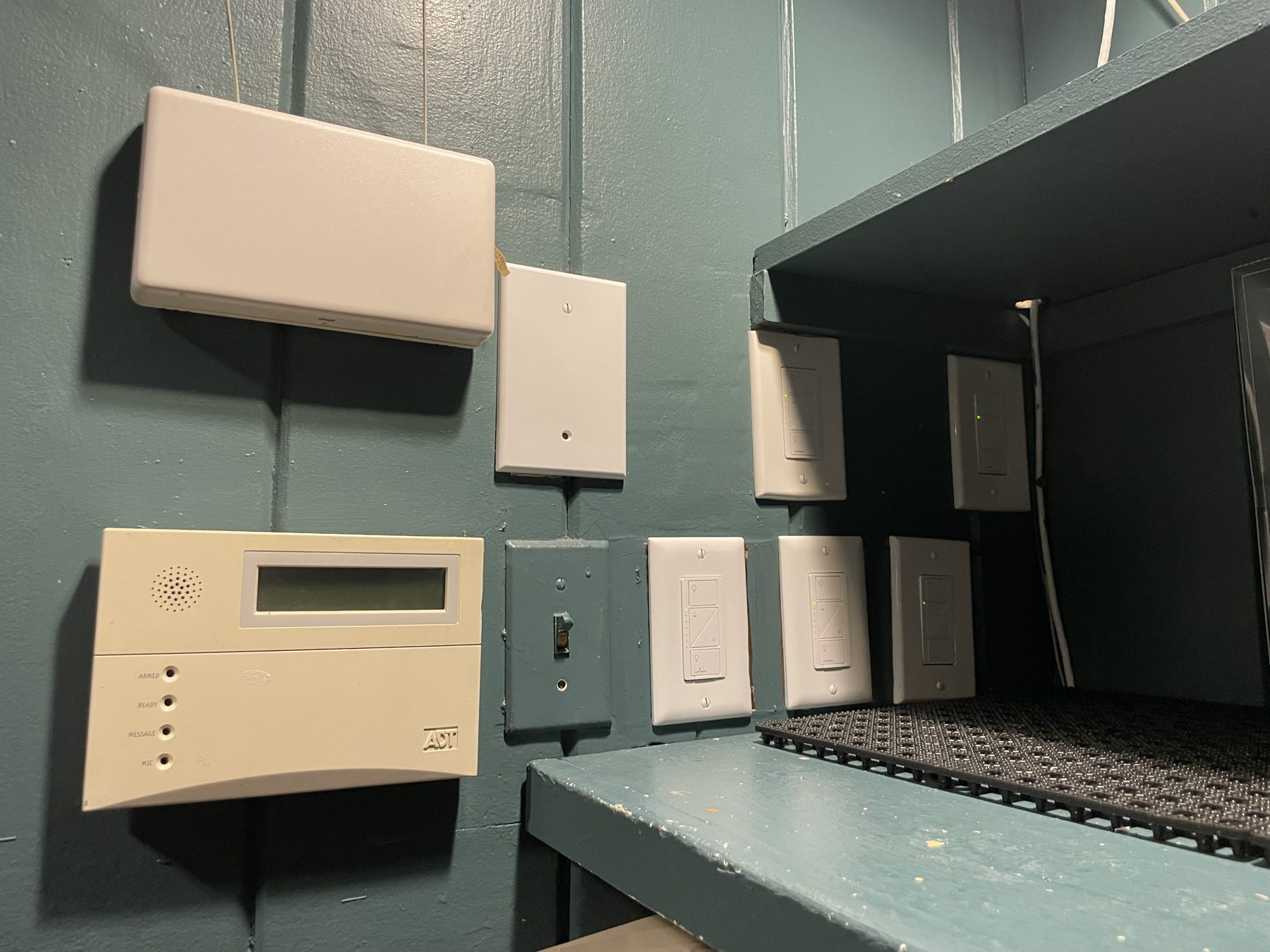
I get asked this at cookouts. Somebody finds out what I do, and the question is always some version of the same thing: what should I actually get?
Here’s my honest answer, and it’s going to sound like a dodge until I explain it. If you’re outside our service area — we cover Maryland, Virginia, and West Virginia — go to Alarm.com’s website and find your local dealer.
That’s it. That’s the recommendation. The rest of this post is why.
Do you want to be the product, or do you want to install the product?
This is the frame I keep coming back to.
The established security companies — Alarm.com, DSC, Honeywell — built their businesses on securing homes. That’s the product. You buy equipment, you pay for monitoring, and the company makes money because you paid them to keep an eye on your house.
The newer consumer smart-home brands came out of companies whose core business is something else entirely. Ring is Amazon. Nest is Google. I’m not going to pretend I know what’s in their roadmap. But it’s worth being clear-eyed about what business you’re walking into, because the incentives are different, and incentives are what predict behavior over 10 years.
I spent just under 5 years at Alarm.com as a product manager. That company is sitting on 20-plus years of customer usage data — when people arm and disarm, entry and exit patterns, the rhythm of how a household actually moves. In my time there, the goal was never to market products back to the customer or to sell that data. The goal was securing the home or the business. That’s my experience from the inside. It’s my read, not a promise I can hand you in writing.
What the FTC found at Ring
Here’s the part that isn’t my opinion.
In 2023, Ring settled with the FTC for $5.8 million over how it handled customer video. The complaint said employees and outside contractors could get at customer footage whether their job required it or not, and it documented cases of staff watching women’s private videos. Ring disputed the allegations.
I’m not raising it to take a shot at anybody. I’m raising it because when I talk about the difference between a security business and a data business, people hear a hypothetical. This one isn’t.
The part nobody markets
This is the unglamorous layer, and it’s where the professional gear quietly earns its money.
Your sensors have to tell the panel that something happened. How they do that is a choice, and it’s not a choice anybody selling you a system brings up.
Professional systems — DSC, Honeywell, 2GIG — use radio built for one job and nothing else. It isn’t shared with your lights or your speakers. It exists because a door sensor has exactly one thing to say, and it needs to arrive.
Ring Alarm’s sensors talk over Z-Wave, the same general-purpose smart-home radio that runs a lot of lamps and door locks. Z-Wave is fine. It just wasn’t built for this in particular, and I’d rather the thing watching my house not share a lane with a light switch.
The other piece worth knowing is about cameras. Alarm.com sends video through an encrypted tunnel, which means your cameras stay private even when your home network isn’t — if your Wi-Fi is wide open, or somebody gets onto it, the video isn’t sitting there for the taking. That’s in their published dealer documentation, not something I’m recalling from a meeting.
Central monitoring vs. self-monitoring
These two terms get thrown around like everyone knows the difference, so:
Central monitored means your alarm signals get forwarded to a monitoring company. A human being there verifies the alarm, tries to reach you, and dispatches emergency services based on what they find out.
Self-monitored means you see all of that traffic yourself and you decide what happens. In practice that’s a push notification on your phone. There’s nobody making a call on your behalf.
Why self-monitoring is winning
Most of our customers today choose self-monitoring. They still want to know if the alarm trips, and they want an easy way to reach emergency services themselves — they just don’t want it happening automatically without them.
Three things drive that, and only one of them is what you’d expect.
They don’t want another monthly bill. This is the obvious one and it’s real.
They’re worried someone is watching. Customers tell me they don’t love the idea of a stranger having eyes on their cameras or their home without permission. I want to be careful here: with a legitimate central monitoring company, that isn’t how it works. This one is a perception problem more than a real risk. But perception is what people buy on.
Somebody got burned, and they remember. I’ve had customers tell me stories that are 20 years old — ADT-era — where dispatch took too long, a break-in happened anyway, and they walked away feeling like they hadn’t gotten the thing they’d been paying for every month. That kind of story doesn’t fade. It gets told at cookouts too.
Nobody guarantees any of this
Here’s the caveat I want in this post more than anything else in it, and it applies to every company I’ve named, including the ones I recommend.
Every monitoring agreement I’ve read describes best effort, not a guaranteed outcome. All of it depends on internet, cellular, and cloud infrastructure that can have problems on any given day. From the industry’s own perspective, this is best effort. It is not a guaranteed service.
That’s not a knock on any one company. It’s structural. It’s how the whole thing works, and anybody who tells you otherwise is selling.
What I have actually watched happen
What I’m about to say cuts against the thing I just defended.
Across the life of the business, with roughly 30 monitored accounts — about a third of them on central monitoring — I can’t point to a single case where central monitoring caught a real break-in for one of my clients and police were dispatched for an actual intrusion. What I have seen, more than once, is the opposite: emergency services dispatched for false alarms.
A Qolsys IQ panel’s built-in glass break sensor failed and triggered a glass break alarm with no glass broken, nobody home, and no doors or windows opened — we checked the interior camera footage afterward and there was no loud noise at all. We replaced the panel and the problem went away. Sensors have been knocked loose and reported as a tamper alarm, which sounds immediately. A cat knocking something off a counter has triggered a glass break sensor. Motion sensors marketed and installed exactly to spec as pet-immune have still been set off by pets. And at a client’s home, a carbon monoxide detector failed and triggered an alarm while everyone was asleep — the fire department responded, and there was no CO issue at all.
None of this is any one manufacturer’s fault. It isn’t Qolsys’s fault that a glass break sensor built into their panel goes bad. It isn’t the CO detector maker’s fault that a sensor fails. It isn’t reasonable to expect a motion sensor to perfectly distinguish a pet from an intruder every time. These are best-effort devices, and when one reports an alarm, the central monitoring company is doing exactly what it’s supposed to do with the data it’s given. The problem is the data itself.
So while central monitoring absolutely acts on what it receives, and that part works as designed, what I’ve observed — installed and calibrated correctly, per every manufacturer’s own specification — is more false dispatches than real catches.
So where does that leave you
I think DIY and self-monitoring keep growing. That trend isn’t going to reverse, and honestly a lot of the time it’s the right call for the household.
I said above that the monthly-contract companies provide something self-monitoring can’t replicate — a person whose job is to notice, verify, and call. I still think that’s true in principle. A push notification on a phone that’s face-down in another room is not the same thing as a human being.
But I have to be straight with you: my own client base has not produced the case that proves it, and it has produced several that cut the other way. Roughly 30 accounts is not a big enough sample to tell you what to do with your house. It is big enough that I’m not going to sell you central monitoring as the obvious upgrade, and I’d rather say that than give you the version that sounds better.