The speaker behind the screen
Why I moved my own theater to an acoustically transparent screen, and what my clients never notice about it.
My first theater was set up the way most rooms are. The left and right speakers flanked the screen — outside the left and right edges of the picture — and the center channel sat immediately below it, tilted up a little toward our ears at the seating position.
The speakers were not the problem. They were Klipsch Reference: two RF-7 II floor standers up front and an RC-64 II center channel. That is serious hardware.
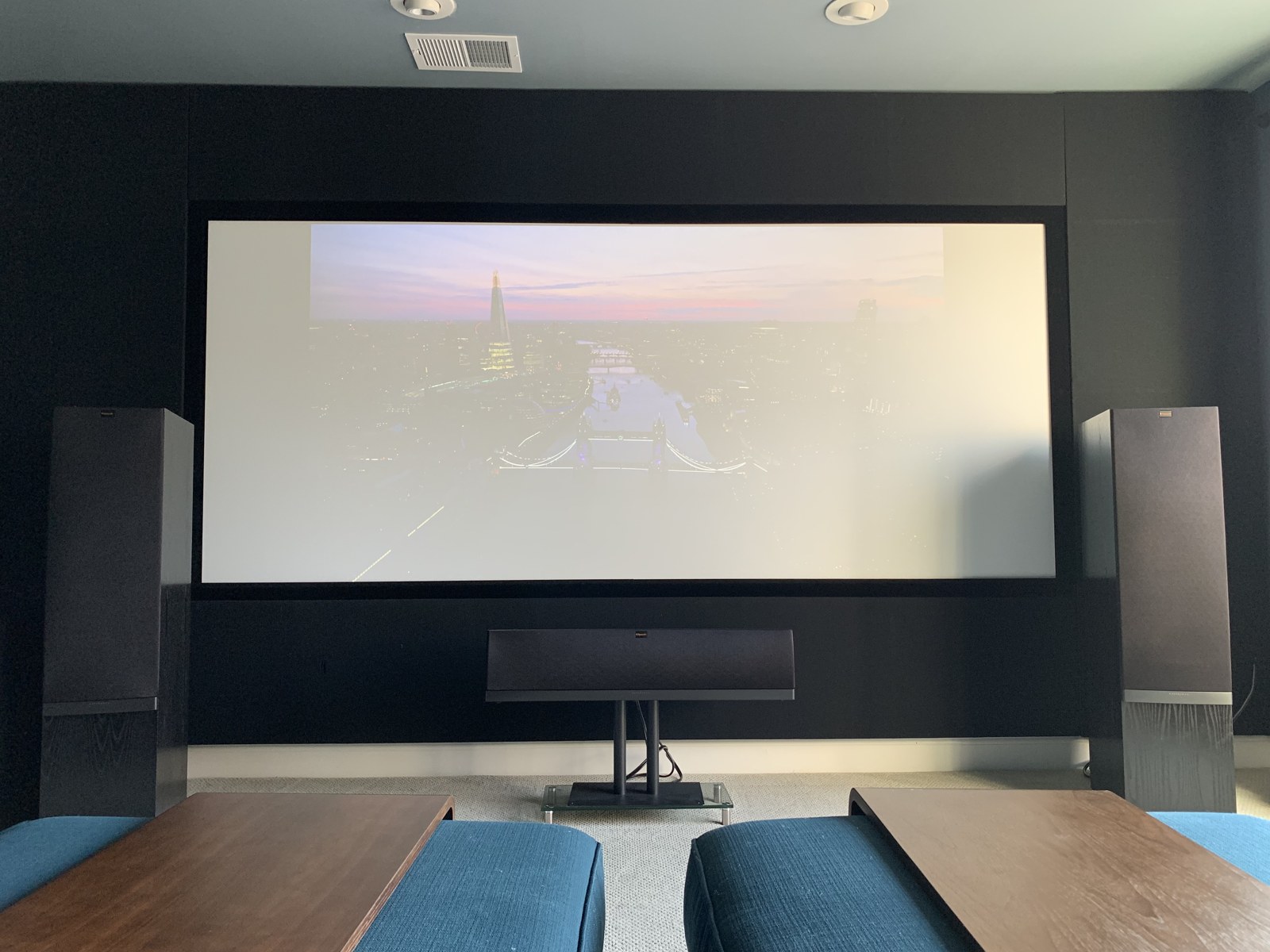
The problem was that I could hear where they were. Voices and sounds came from off the screen — left, right, or below it. An actor was in the middle of the frame and his voice was coming from under his feet.
I noticed it right away. And then I got used to it.
The same thing happens in every living room in America. You put an 85″ or a 100″ TV on the wall, you shove the center channel or the sound bar below it or above it, and the sound comes from that spot. Your brain gets used to it. That is not in question — you definitely get used to it. And it does not sound bad.
But when a film is mastered and authored, the intention is for the sound to come from where the action is. If there is an explosion on the screen, the sound should come from that spot, or close to it. If there is an actor in the center of the frame talking, the voice should come from there. Not below them. Not above them.
The room where you do not have to compromise
A dedicated home theater is one of the few places where the user generally does not have to make compromises like this.
If you want speakers behind the screen but you do not have the depth for a false wall, you do in-wall speakers. (In-wall versus bookshelf is its own heavily contested argument, and it is not this post.) If you do have the room for a false wall, then the real question is whether you put the speakers behind the screen at all.
And that is where the industry splits, completely. Audiophiles think an acoustically transparent screen jeopardizes the audio. Videophiles think the same screen ruins the picture. There is no winning with either group.
The second theater
My second theater is the one that went acoustically transparent. A 143″ CinemaScope screen, with the speakers behind it.
What I noticed was something I stopped hearing. No more audio off to the sides and under the screen. What I got instead was a smooth pan across the front of the room.
Some of that credit goes to the screen and some of it goes to what went behind it. I had already moved to three matching floor standers across the front instead of two towers and a horizontal center — three RF-7 IIIs, no RC-64 III. To be fair, a smooth pan is achievable with a horizontal center channel. But three identical cabinets mean a sound crossing the front stage stays the same sound the whole way across.
Four sets of LCRs have been behind that screen. The reasons they changed are not the reasons you would expect.
Why I kept swapping them out
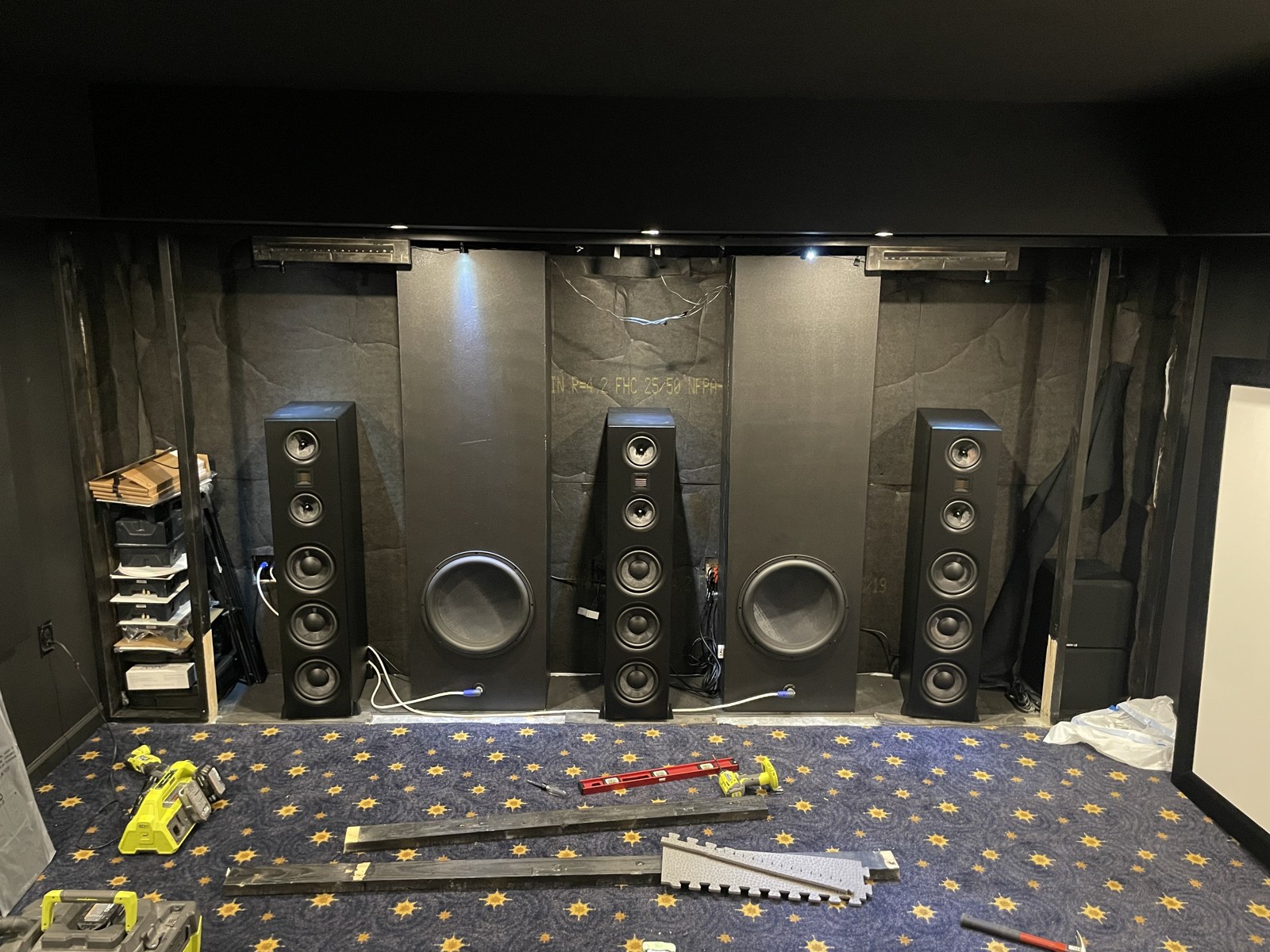
After the RF-7 IIIs I built my own. DIY Sound Group HT-12s, in the LCR positions.
That was not an upgrade decision in the audiophile sense. The DIY cabinets were shallower than the Klipsch, and they were front ported instead of rear ported, which matters when you are thinking hard about the depth of your room. And I wanted to build a set of speakers. This was before Bright Wire Solutions — it was my personal theater, not a demo theater I was showing to clients.
Then the room’s job changed. Once we became Bright Wire Solutions and were designing theaters, being able to demonstrate something like a big projection screen and a real front stage got more and more important. So I sold the DIY Sound Group HT-12s to buy Episode Home Theater Reference in-room LCRs — two 6½″ woofers flanking a module that carries a dome midrange and a dome tweeter together, so a three-way in an MTM layout. I went to Episode because it is the house brand from where we buy.
After that came a three-way design from Emotiva, the XT3. That one was curiosity as much as anything. I have always loved Emotiva’s electronics — their amps and processors have always been fantastic value versus performance — and their speakers reviewed very well, so I wanted to try them. They held up. I run them at a lower crossover so they are closer to full range, and they sound great.
I never sold a pair. That happens more than you would think. You run a full audition cycle, you live with the product, you decide you can stand behind it, and it still never makes it onto a job.
The speakers I underrated
Of all four, the widest dispersion belonged to the homemade ones.
The HT-12s use a compression driver into a SEOS waveguide, and the dispersion pattern off that horn is very, very wide. Which means they were less localizable — the sound does not pin itself to the cabinet the way a narrower pattern does. In the room that showed up as a bigger front stage.
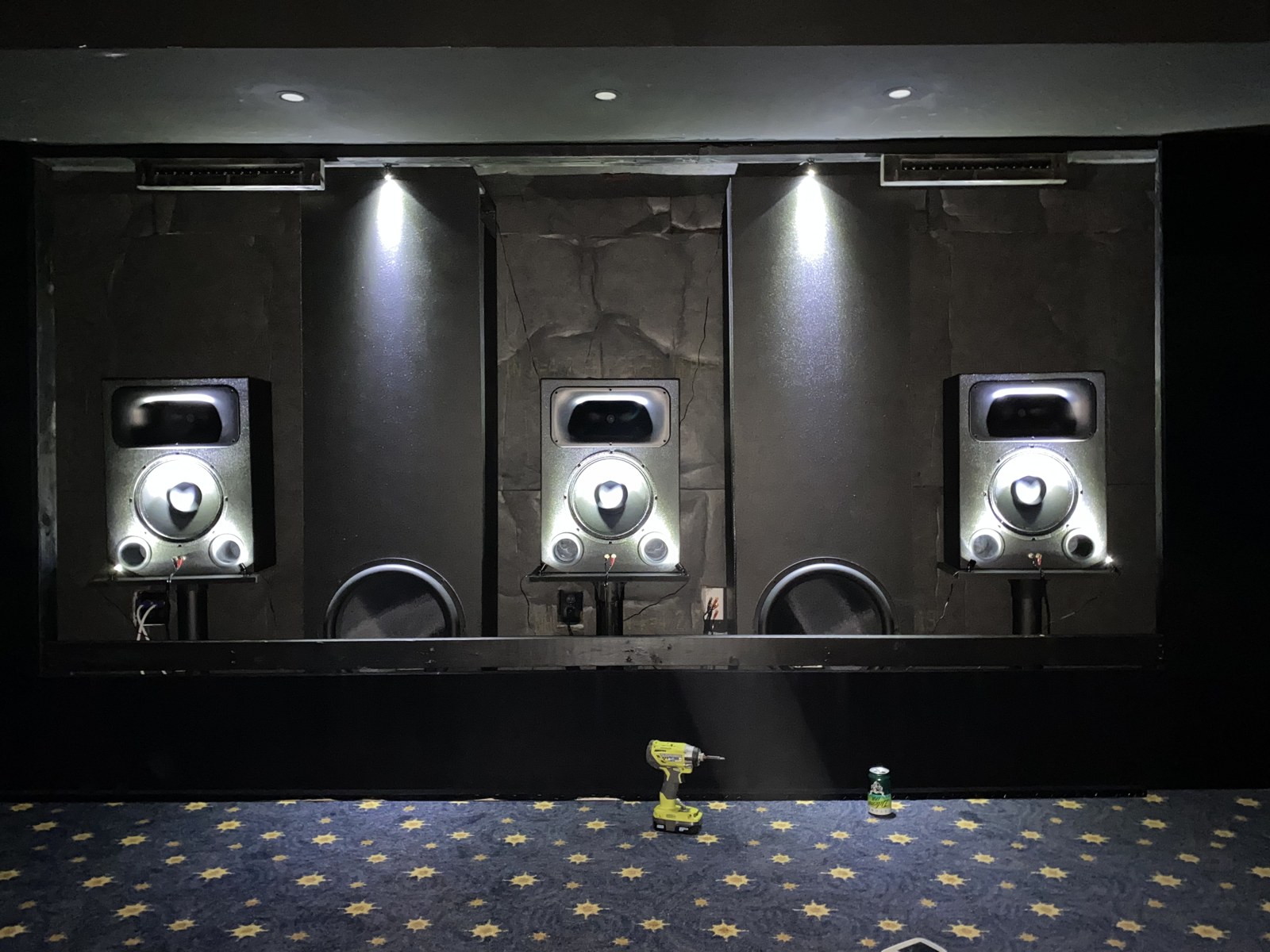
I did not truly realize it until I took them out.
That is the same problem the screen solves, approached from the speaker side. The screen stops you from locating the speaker because the speaker is behind the picture. A wide dispersion pattern stops you from locating it because the sound is not arriving from one tight place. Both are working on the same thing: keeping your attention off the hardware.
The complaints I did not run into
The screen is a Seymour AV Center Stage XD.
Moiré, visible texture, light loss — I did not see any of it. I did not have to change the projector or lower my expectations to compensate for the screen. That is one room and one material, not a universal finding. But the two things each camp warns about did not show up in my theater.
What clients actually notice
Nothing.
When someone sits down in that room and the dialogue comes from the actor’s mouth, they do not comment on it. They are not being distracted by sound coming from somewhere else. The compliment is the absence of a complaint.
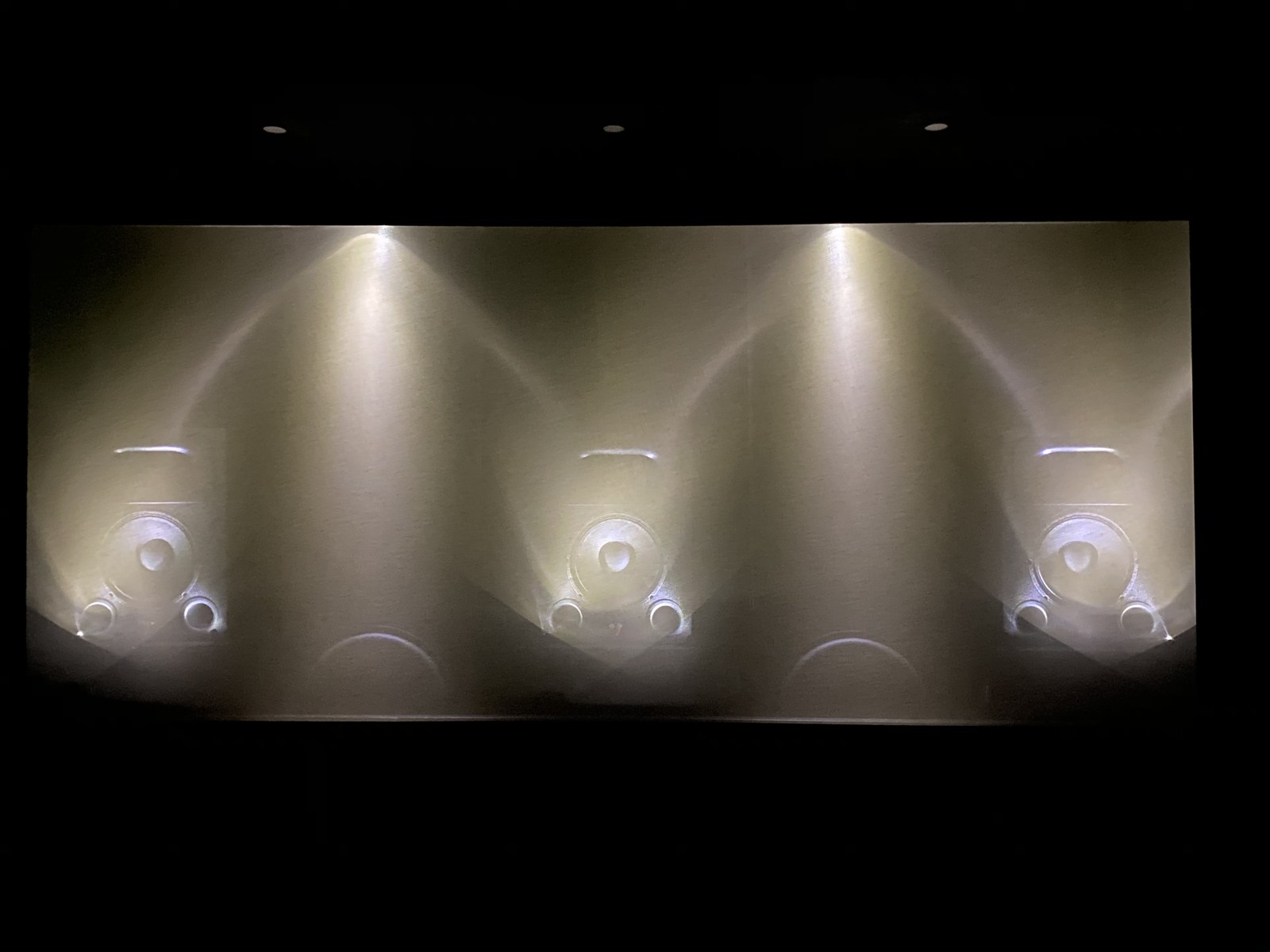
When I explain it to people, I do not start with fabric weave or light loss. I ask whether they have ever been to an IMAX movie where they turn the lights on behind the screen before the show — so you can see the scaffolding, and all the different channels of speakers hanging back there. That is how movie theaters do it. That is how I personally want it done.
Where this decides the display
You cannot make an LED wall acoustically transparent. MicroLED, direct view LED — the panel is the picture, and sound is not going through it. So with an LED wall the left and right speakers flank the screen and the center channel goes above or below it. That is not the same as the sound coming from the character on screen.
This is a true differentiator for projection. The industry is split on acoustically transparent versus non-A/T, but with projection you at least have the option. I wrote about why projection isn’t going anywhere when MicroLED was having its moment — and this is the part that post never got to.
Has it swung a display decision? Definitely. If someone’s viewing is not 100% sports or 100% video games, if it is mixed use leaning toward cinematic films, this has absolutely pushed the room toward projection.
But it is not really about winning or losing a sale. My clients generally arrive with the category already decided. They might not know which TV or which projector they want, but they are usually pretty set on the kind of setup they are looking for. What we do is explain the pros and cons of any setup, so they know what they are trading away.
The trade is real either way. Every display makes compromises in order to be good at something specific.
What I keep coming back to is that the sound is part of what tricks your brain — the immersion, the theatrics. It should bring you in, not pull you out.