The room should disappear
Home theater design isn't about the wow factor. It's about what happens to light and sound after they leave the screen.
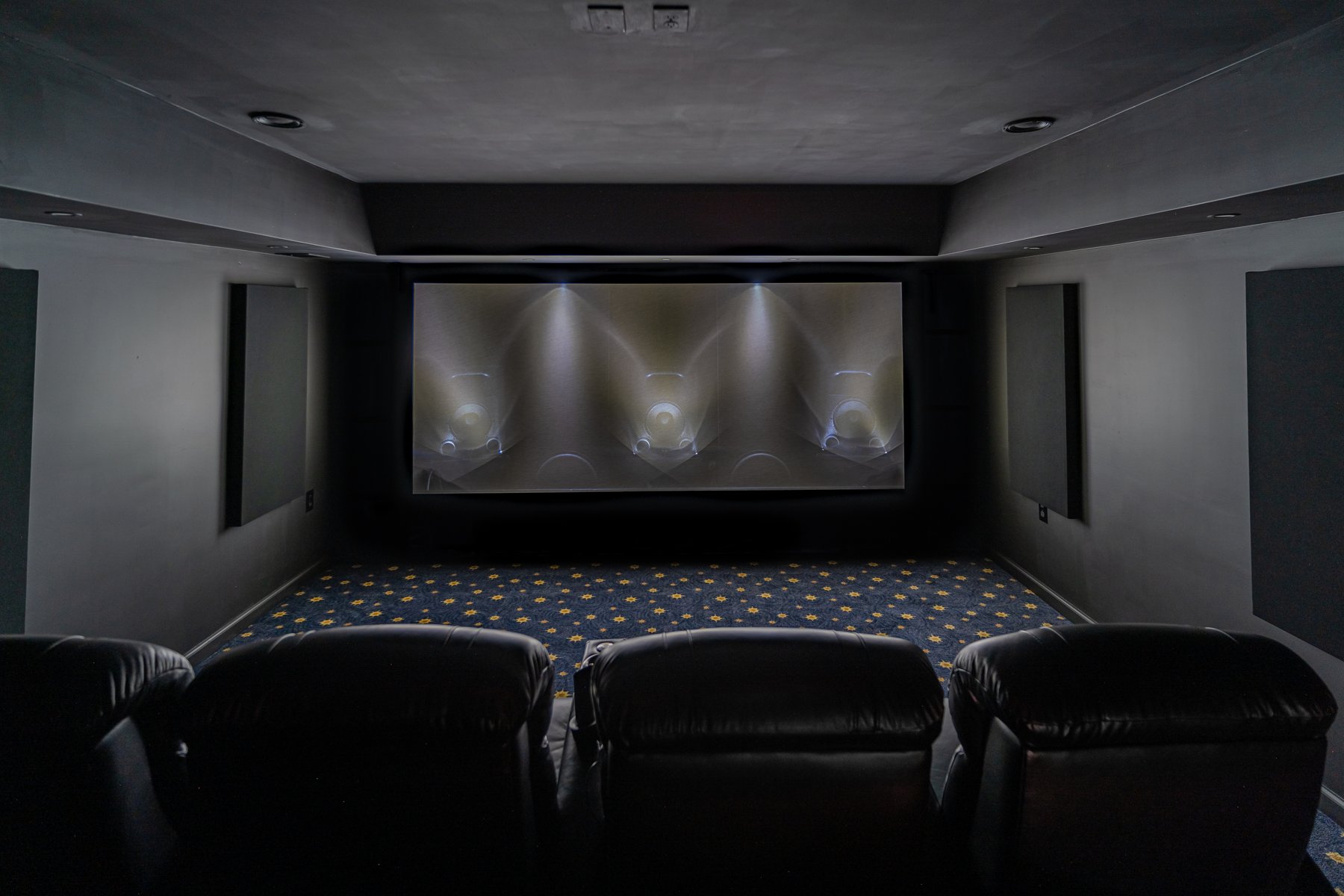
The most common mistake I see in home theater design isn’t a gear choice. It’s light carpet, light walls, and a light ceiling.
It’s an easy thing to demonstrate. Hold up a black velvet panel next to a projected image and the difference is immediate. What people don’t intuitively grasp is why: the brightness we perceive isn’t just what comes out of the projector, it’s whatever light makes it back to our eyes, however it gets there. Some of that light comes straight off the screen. But a lot of it bounces first — off a white ceiling, off light-colored walls, off pale carpet — and every one of those bounces adds light back into the room that has nothing to do with the image itself. In the industry we call this perceived contrast, and it’s a different thing from the actual contrast spec printed on a projector’s box.
That distinction matters because it changes what you’re actually paying for. I can make an expensive projector look good in almost any room. I can make a modest projector look considerably better than its price tag suggests, just by controlling the room around it. An expensive projector in a properly dark room will still beat a modest one in the same room — good gear in a good room always wins. But a lot of people spend their entire budget on the projector and none of it on the room, when the room is half the equation. It’s the same trap as paying for the bigger number on the spec sheet: the jump you can see and the jump you’re billed for aren’t always the same jump.
Sound works exactly the same way, and it’s just as often ignored. Hardwood floors look great and create echo. Acoustic panels get skipped because people don’t like how they look on the wall, even though you can now get them printed with your own artwork so they read as decor instead of foam. It’s remarkable how much money people will spend on the electronics and how little on the room, when a rug and a few well-placed panels are often the cheapest, highest-impact thing you can do. None of this replaces working with someone who designs the room as a whole — the acoustics, the light control, and the layout have to work together, not get bolted on separately.
This isn’t just intuition — it’s consistent with how the industry’s own standards are written. Dolby’s Atmos home installation guidelines call for the ceiling to be flat, not angled or vaulted, and made of an acoustically reflective material like drywall, plaster, or hardwood — specifically because the first reflection off the ceiling is what makes overhead sound work, and anything that absorbs or scatters that reflection undermines the effect. The visual side follows the same logic in reverse. Light and sound are governed by the same physical fact: surfaces you don’t control will do something to whatever hits them, whether you planned for it or not.
The goal, in both cases, is for the room to disappear. For light, that means the eye stops noticing walls, ceiling, and floor, and just sees the image. For sound, it means the ear stops noticing individual speakers and just hears the film. Done right, you shouldn’t be able to point to where a voice or a footstep is coming from — it should just seem to come from the room itself, ideally from wherever it’s happening on screen.
That’s the reasoning behind one of the more contested choices in the industry: putting speakers behind an acoustically transparent screen. Audio purists tend to say no, video purists tend to say no, and audiences, in my experience, tend to like it. What you gain is dialogue and sound actually originating from where the action is on screen, instead of from a soundbar below the picture or towers flanking it. Music pans across the front stage without a gap in the middle, and on-screen sound doesn’t seem to be coming from off to the side. There’s no setup that makes every kind of listener happy — it really does come down to the client. But if it were entirely my call, I’d put the front speakers behind the screen, the surrounds and height speakers in the walls and ceiling, and the subwoofers hidden as well. I don’t want sound coming from a specific, identifiable spot in the room. I want it to sound like it’s coming from the room.
I’ve never had a client go fully dark and regret it, in the same way I’ve never had a client go too big on a screen and regret it. What I have seen, more than once, is the opposite: people who under-built — TVs bought a size smaller than they should have, rooms left half-bright because someone wanted to split the difference, speakers left out in the open because hiding them felt like too much effort.
Here’s the thing I actually tell clients: the room gets to show off when the lights are on. That’s when you want the wow factor — a star ceiling, ambient lighting, whatever gives the space its personality before the movie starts. But once you’re deep into a film you actually care about, you don’t want to be aware of the room, or the walls, or where the sound is technically coming from. You want all of it to disappear, so the only thing left is the film.