Outdoor projection got real. It still doesn't just win.
A 100-inch screen that puts itself away costs about what a 65-inch full-sun TV does. The TV will probably look better.
For years, if you wanted a real screen outside, the serious option was an outdoor-rated TV. Samsung’s Terrace is where most people end up. The model built for direct sun is the Full Sun LST9D, and at 65” it’s $7,499.99 on Samsung’s site. It comes in 65” and 75”. The Partial Sun LST7D, meant for shade and covered patios, is $4,999.99 at 65”.
At CEDIA Expo in Denver, AWOL Vision had an outdoor setup that made those numbers look different. I already wrote about their booth, and the same caveat applies here: we haven’t installed any of this.
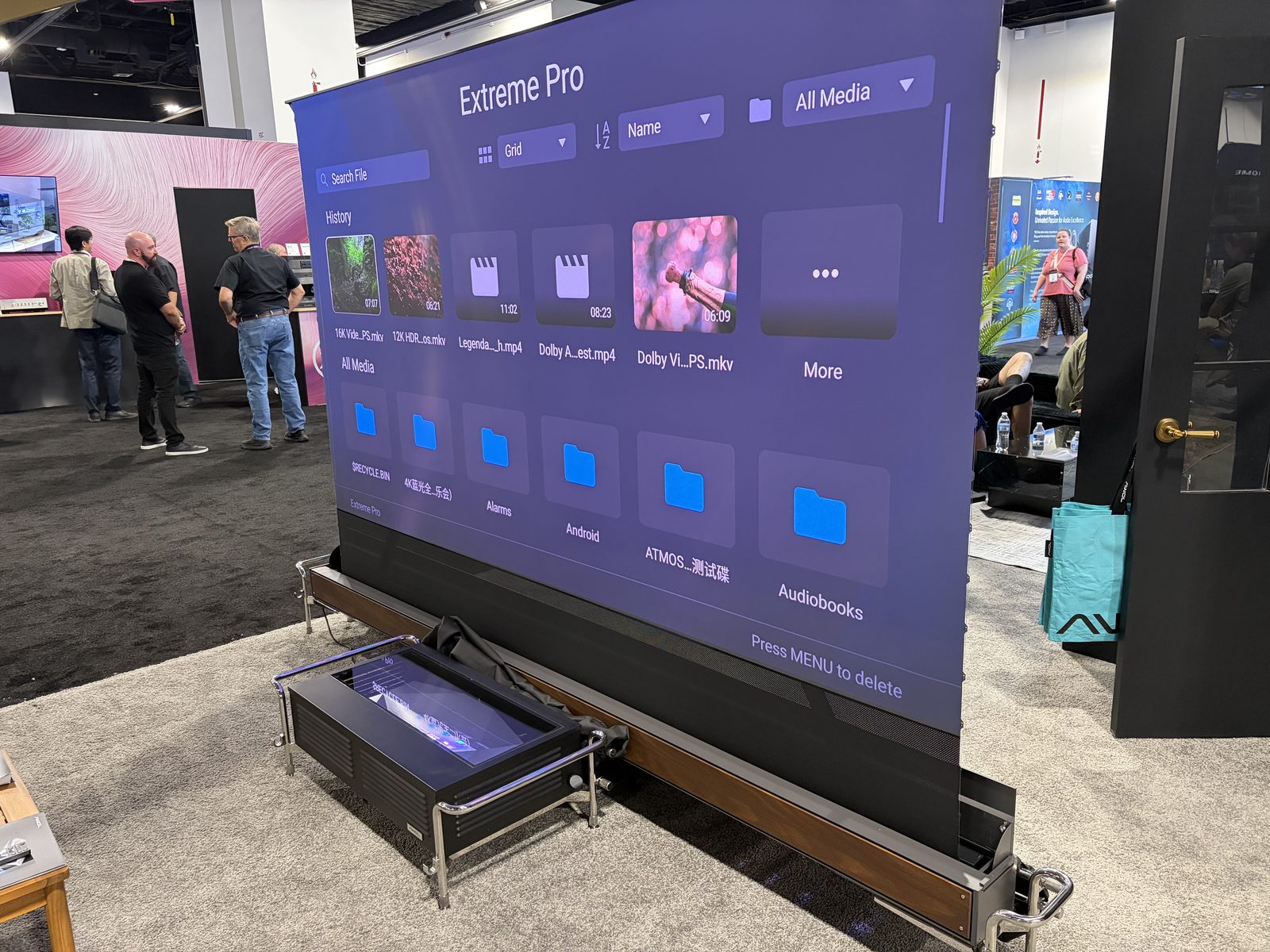
The screen is motorized and rises up out of a base at floor level, the kind of thing you could build into a deck or run along a railing, then lowers itself out of sight when you’re done. The projector sits in its own enclosure with active cooling, and there’s room in it for a streaming box or a game console. It can be set up on a deck or hung from a ceiling depending on the space.
They quoted me around $8,000 for the whole package. That gets you 4K projection that holds up in outdoor ambient light, a screen that’s gone when nobody’s watching, and a projector that isn’t just sitting out in the weather.
I left the booth planning to call that enclosure weatherproof. AWOL doesn’t. Their description is a “waterproof, dust-proof design for semi-outdoor use,” and I couldn’t find an IP rating published for it. They also sell a separate cover that goes over the box when it’s not in use. That’s it bunched up behind the box in the photo.
That kills the argument I was going to make, which was that outdoor TVs need a cover and this doesn’t. It needs one too. You’re still covering something at the end of the night. It’s just the box instead of the TV.
So for about the price of a 65” Full Sun Terrace, you can have a 100”-plus image and a screen that puts itself away. For the right yard, that’s a good trade.
A full-sun TV will probably still look better, though. It’s brighter, the color holds up, and it doesn’t care where the sun is. A smaller bright picture beats a bigger washed-out one. Which one wins depends on how much light hits that wall at 7 p.m. in July, and the only way to know is to go stand there before anybody quotes you anything.
Outdoor TVs aren’t going anywhere, and plenty of jobs call for a screen that’s always there. What’s different now is that outdoor projection is a real option instead of something you talk a client out of on the phone.